

Laparoscopic Hernia Surgery vs Open Surgery: Which Is Better?
axiom2026-09-26T06:23:40+00:00Hernia is one of the most common surgical conditions affecting both men and women. Many patients experience swelling, pain, heaviness, or discomfort in the abdomen or groin area but delay treatment due to fear of surgery.
Today, surgical technology has advanced significantly, and patients now have access to minimally invasive laparoscopic hernia surgery alongside traditional open surgery. One of the most common questions patients ask is:
“Which is better — laparoscopic hernia surgery or open surgery?”
The answer depends on several factors including:
- Hernia type
- Hernia size
- Patient health condition
- Previous surgeries
- Recovery expectations
- Surgeon expertise
Understanding the difference between these procedures can help patients make informed treatment decisions.
Dr. Manoj Sharma provides advanced minimally invasive hernia treatment using modern laparoscopic techniques in Agra.
What Is a Hernia?
A hernia occurs when an internal organ or tissue pushes through a weak area in the abdominal wall or surrounding muscles.
Common types include:
- Inguinal hernia
- Umbilical hernia
- Incisional hernia
- Femoral hernia
- Hiatal hernia
Symptoms may gradually worsen over time and can interfere with daily activities.
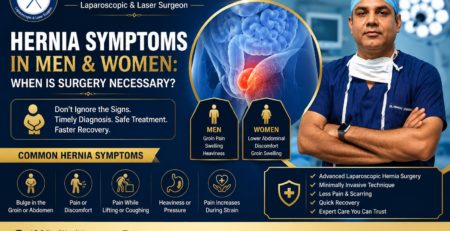
Common Hernia Symptoms
Patients with hernia often experience:
- Swelling or bulge in the abdomen or groin
- Pain while lifting or coughing
- Heaviness or pressure sensation
- Burning discomfort
- Pain during standing or physical activity
Ignoring symptoms may increase the risk of complications.
Common Hernia Symptoms
Patients with hernia often experience:
- Swelling or bulge in the abdomen or groin
- Pain while lifting or coughing
- Heaviness or pressure sensation
- Burning discomfort
- Pain during standing or physical activity
Ignoring symptoms may increase the risk of complications.
What Is Laparoscopic Hernia Surgery?
Laparoscopic hernia surgery is a modern minimally invasive surgical technique.
The procedure is performed through small incisions using:
- A laparoscope (camera)
- Specialized surgical instruments
- Surgical mesh for reinforcement
The surgeon views the internal area on a monitor and repairs the hernia with precision.
Because the incisions are much smaller, patients usually experience faster recovery and less pain.
Major Differences Between Laparoscopic and Open Hernia Surgery
- Incision Size
Open Surgery
Requires a larger cut near the hernia site.
Laparoscopic Surgery
Uses tiny incisions, resulting in smaller scars.
Smaller incisions are one of the main reasons patients prefer minimally invasive surgery.
- Pain After Surgery
Open Surgery
Pain and soreness are usually more noticeable due to larger tissue disruption.
Laparoscopic Surgery
Most patients experience less post-operative pain.
Reduced pain often allows earlier movement and quicker recovery.
- Recovery Time
Open Surgery
Recovery may take longer depending on the patient’s physical activity and wound healing.
Laparoscopic Surgery
Patients usually recover faster and resume routine activities sooner.
This is especially beneficial for:
- Working professionals
- Elderly patients
- Physically active individuals
- Hospital Stay
Open Surgery
Some patients may require longer hospital observation.
Laparoscopic Surgery
Many patients are discharged within a short period after surgery.
Shorter hospital stay improves comfort and convenience.
- Scarring
Open Surgery
Produces a larger visible scar.
Laparoscopic Surgery
Small incisions result in minimal scarring.
- Risk of Infection
Open Surgery
Larger wounds may slightly increase infection risk.
Laparoscopic Surgery
Smaller incisions reduce wound exposure and help lower infection chances.
- Return to Work
Open Surgery
Patients may need a longer recovery period before returning to work.
Laparoscopic Surgery
Many patients return to light work earlier.
Comparison Table: Laparoscopic vs Open Hernia Surgery
Feature | Laparoscopic Hernia Surgery | Open Hernia Surgery |
Incision Size | Small | Larger |
Pain | Less | More |
Recovery | Faster | Slower |
Scarring | Minimal | More Visible |
Hospital Stay | Short | Longer |
Infection Risk | Lower | Higher |
Return to Work | Earlier | Delayed |
Which Hernia Surgery Is Better?
For many patients, laparoscopic hernia surgery offers several advantages due to:
- Faster recovery
- Less pain
- Smaller scars
- Early return to routine activities
However, open surgery may still be recommended in certain situations such as:
- Very large hernias
- Complicated hernias
- Specific medical conditions
- Some emergency cases
The best treatment option depends on proper medical evaluation and surgical expertise.
Benefits of Laparoscopic Hernia Surgery
Faster Recovery
Patients often recover sooner and resume normal life earlier.
Minimal Pain
Reduced tissue damage leads to less discomfort.
Better Cosmetic Results
Smaller scars improve cosmetic appearance.
Advanced Surgical Precision
High-definition laparoscopic cameras improve visualization during surgery.
Lower Risk of Wound Complications
Small incisions reduce wound-related problems.
Benefits of Laparoscopic Hernia Surgery
Faster Recovery
Patients often recover sooner and resume normal life earlier.
Minimal Pain
Reduced tissue damage leads to less discomfort.
Better Cosmetic Results
Smaller scars improve cosmetic appearance.
Advanced Surgical Precision
High-definition laparoscopic cameras improve visualization during surgery.
Lower Risk of Wound Complications
Small incisions reduce wound-related problems.
Recovery After Hernia Surgery
Recovery After Open Surgery
Patients may experience:
- More discomfort initially
- Longer wound healing time
- Delayed return to physical activity
Recovery After Laparoscopic Surgery
Most patients:
- Walk within hours
- Resume light activities within days
- Recover faster overall
Heavy lifting is usually restricted temporarily after both procedures.
Recovery After Hernia Surgery
Recovery After Open Surgery
Patients may experience:
- More discomfort initially
- Longer wound healing time
- Delayed return to physical activity
Recovery After Laparoscopic Surgery
Most patients:
- Walk within hours
- Resume light activities within days
- Recover faster overall
Heavy lifting is usually restricted temporarily after both procedures.
Doctor Insight
Many patients continue managing hernia symptoms with temporary measures like belts or pain medicines. However, hernias do not heal naturally.
Early laparoscopic treatment often:
- Reduces complications
- Improves recovery
- Minimizes pain
- Helps patients return to normal life faster
Ignoring symptoms for long periods can make treatment more complicated later.
Frequently Asked Questions (FAQs)
Is laparoscopic hernia surgery painful?
Most patients experience significantly less pain compared to open surgery.
Which surgery has faster recovery?
Laparoscopic hernia surgery generally offers faster recovery.
Is mesh used in laparoscopic surgery?
Yes, mesh is commonly used to strengthen the abdominal wall.
Can hernia return after surgery?
Recurrence risk is lower with proper surgical repair and post-operative care.
How long does laparoscopic surgery take?
The duration varies depending on the hernia type and complexity.
Book Your Consultation
If you are experiencing hernia symptoms such as swelling, groin pain, or abdominal discomfort, early surgical consultation can help prevent complications and improve recovery.
Dr. Manoj Sharma provides advanced laparoscopic hernia treatment with modern minimally invasive surgical care in Agra.
📍 LG-5, Kargil Hospital, Near Laxmi Palace, Sikandra-Bodla Road, Agra
📞 +91 90580 06768
🌐 Dr Manoj Sharma Official Website






Leave a Reply